wrong tool

You are finite. Zathras is finite. This is wrong tool.

  • Email
  • LinkedIn
  • RSS
  • Twitter

Powered by Genesis

Voodoo Debugging in the Age of the Cloud

May 21, 2014 by kostadis roussos Leave a Comment

Software engineers, for all of their deep rational view of the universe, tend to sometimes approach debugging like soothsayers inspecting entrails trying to divine what the hell is going on.


The scene played out like this:

Bug report: XyZZy is happening

Engineer stares at bug report, stares at software, stares at test case that doesn’t reproduce it.

Engineer then tries things that make sense.

Bug doesn’t go away

Then Engineer tries random acts of coding to see if the bug goes away.

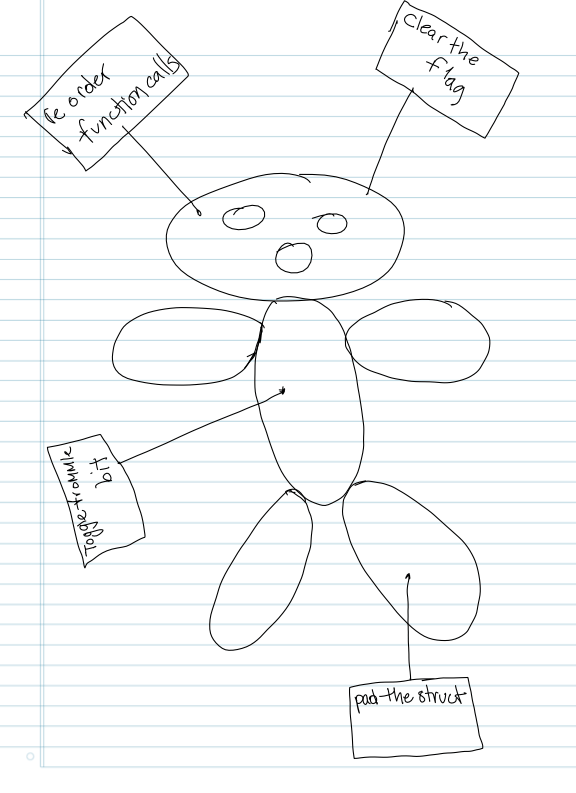
And his peers start saying: Wow, yeah I think I saw something like that. Did you try the toggle the frommlebit?

And the engineer says: But this has nothing to do with the frommle bit, this is tied to pluxion submodule.

And another peer says: Trying adjusting the memory size of the core structure.

And the engineer says: But my code never touches that core structure!

And another peer says: We’ve had success with this kind of problem that we don’t understand when we altered the return value of the function..

And the engineer says: But this makes no sense.

And they all respond like a Greek chorus: But it sometimes works.

At this point in time the engineer is hoping and praying that just moving the code around will cause the bug to go away.

My buddy and I used to call that last stage of debugging “Voodoo debugging”.

voodoo debugging

You don’t understand the problem, you don’t understand why the bug is happening, you have a deadline to meet, so you try random things hoping that the bug will just go away.

And the sad truth is that the simple act of moving things around may cause the bug report to go away. The bug may reappear later in some other poor bastards bug queue. And the Voodoo debugging will continue as people try this and try that.

In the pre-cloud era of computing, when software engineers believed that it was their divine right to understand how it all fit together, this was viewed as a moral failing. Back in the day we could understand how the entire system from the silicon up worked and we could use that information to thoroughly debug and understand the problem.

Those who lacked the moral fiber and intellectual rigor to do real software engineering practice Voodoo debugging. The rest of us understood how the entire system fit together and resolved the issue down to it’s root cause.

Then I moved to Zynga. And at Zynga it became apparent that Voodoo debugging wasn’t just a product of a lack of moral fiber or intellectual rigor it was a rational response to the environment.

I talk about this a lot in an answer on Quora. The essential elements of the arguments are that systems are in such continuous flux that understanding how the system is working in its entirety is impossible and worse by the time you understand it, the system has changed.

Bugs come and bugs go. And bugs have an element of Voodoo magic about them. Trying to understand bugs and resolving them is impossible. We are now in the era of trying to resolve issues without fixing them. We have become doctors who offer palliatives rather than cures in the hope that the problem will just go away.

And so I embrace my inner Voodoo doctor. I will try the magic cants, I will pray that the next update of the API I am using fixes the problem, and I will internalize the truth that finding the root cause is an illusion my earlier me had.


Share this:

  • Email a link to a friend (Opens in new window) Email
  • Share on Reddit (Opens in new window) Reddit
  • Share on X (Opens in new window) X
  • Share on Tumblr (Opens in new window) Tumblr
  • Share on Facebook (Opens in new window) Facebook
  • Share on LinkedIn (Opens in new window) LinkedIn
  • Share on WhatsApp (Opens in new window) WhatsApp

Like this:

Like Loading…

Filed Under: innovation

Joe Thornton and Smart Systems

May 11, 2014 by kostadis roussos Leave a Comment

On Dec 1st, 2005, the Boston Bruins made a catastrophically piss poor decision to trade Joe Thornton to the San Jose Sharks. As a result of that trade, San Jose became a perennial contender. Boston did eventually become a great great team, but the trade of Thornton could only be described as the agonizingly slow route.

The rationale for the trade was the belief in the gutless Thornton mystique, a story created from the nonsense of his first foray into the playoffs when with a broken rib he was only able to get one measly assist in a 7 game series loss to the Montreal Canadiens.

Over the years I have seen Joe Thornton carry mediocre San Jose teams to the playoffs only to be continuously thwarted by Doug Wilson’s inability to get a decent third line…

Or so I think …

My point in all of this, is that Joe Thornton, to anyone who knows hockey, is most definitely not a Bruins player…

Unfortunately Facebook’s algorithms are a little bit less aware of the NHL and hockey… and produced this trending result:

Facebook 

  • Joe Thornton: Bruins’ Thornton fined $2,800 for squirting water

And herein lies the danger of computers and their lack of semantic awareness. They create such delightful moments of absurdity. The algorithms confused Joe Thornton with Scott Thornton.

Without any knowledge of the internals of the implementation, I could suppose that Facebook used the fact that I post stuff about Joe Thornton, including posts I have made about how he once played for the Bruins to surface a note about Scott.

This is the inherent danger in an era of big data. We have all of this data that we can then use clever algorithms to create interesting and useful results that we can immediately share with the world. And most of the time the results are good.

The problem arises when the result is not good

And it’s not that computers are less reliable than human beings, humans are just as prone to absurd errors, the problem with computers is how we humans are interpreting the results. Or choosing to share the results without interpreting them because they are correct most of the time.

The key difference with the past is that the computers had access to less data, so our ability to find relationships where none existed was limited. We knew that the data was too small to trust any result that did not fit our intuition.

But now, with so much data, who is to say that the relationship doesn’t exist?

Perhaps our clever algorithms did find relationships that were only possible because of the amount of data we had collected.

And so we need to be careful and humble as we look at the results. Sometimes we will find things in the data that we didn’t know existed, and sometimes we might be looking at the night sky and seeing a horse in the stars.

Because, I can assure you that Joe Thornton is both not a Bruins player and not playing hockey right now.

And as I review my post, it’s tempting to ask myself – maybe the data is telling me a truth that Joe Thornton is not as great in the playoffs as I think he is. Maybe I need to listen the fact that he was -6 and scored only 3 points  this year and that that had something to do with the performance of the Sharks. Maybe. Or not.

Share this:

  • Email a link to a friend (Opens in new window) Email
  • Share on Reddit (Opens in new window) Reddit
  • Share on X (Opens in new window) X
  • Share on Tumblr (Opens in new window) Tumblr
  • Share on Facebook (Opens in new window) Facebook
  • Share on LinkedIn (Opens in new window) LinkedIn
  • Share on WhatsApp (Opens in new window) WhatsApp

Like this:

Like Loading…

Filed Under: innovation

Big steak vs Tasting menus and the difference between storage and network system architecture

May 4, 2014 by kostadis roussos Leave a Comment

As a lover of fine cuisine, I am always struck at the difficulty of choosing between a tasting menu and a massive steak. The tasting menu is about sampling a little bit of a lot of things. The chef is trying to maximize the number of unique flavors over calories. Whereas when you eat a steak you are trying to maximize the number of steak calories.

Tasting menu is about doing a lot of little things.

Steak is about doing a lot per thing.

And that is a very crude analogy about the difference between storage and networking.

If we consider a packet a unit of work, storage systems expend a lot of resources per packet as compared to network devices and so process vastly fewer packets.

Storage system architecture must optimize the use of very slow devices. The slower the device the more computation value you get out of clever algorithms on a per packet basis if they can avoid going to disk. So storage uses complex in-memory data structure with complex algorithms that blow out data caches because storage systems have to. The reason flash was so disruptive to the storage industry is because the amount of computation per packet became less as the performance of flash closed the CPU vs storage performance gap.

Network system architecture must, on the other hand, do the minimal amount of work because it is inherently slowing down the flow of electrons. A beam of light down a cable that hits a network device feels like it went from light speed to impulse speed. As a result networking systems must do heroics to minimize the amount of computation and simultaneously make the computation go as fast as possible.

Practically what this means is that a network system can benefit hugely from custom specialized computational hardware whereas storage can not.

In English: ASIC for networking making sense, no one uses anything but Intel CPU for storage. And every company that tried to use custom hardware in
storage.

This answers a long standing question I had, as to why storage companies never used custom computational hardware and networking companies did.

It also answers why server companies go after storage and not networking: the hardware server companies build is more aligned to a storage problem than a networking problem. For example Sun and Dell and HP went after storage in a way they never went after networking.

This also answers the mystery Cisco. Much like Intel won the server CPU war, a single dominant player can emerge in networking given the need for custom hardware. At some point in time only a small number of players can play the game.

And last it answers the software defined storage mystery. In software defined networking we move control out of the hardware device. Software defined storage just says I can run control and data path code on any piece of hardware… This is an important distinction that is not obvious.

Coolness.

Share this:

  • Email a link to a friend (Opens in new window) Email
  • Share on Reddit (Opens in new window) Reddit
  • Share on X (Opens in new window) X
  • Share on Tumblr (Opens in new window) Tumblr
  • Share on Facebook (Opens in new window) Facebook
  • Share on LinkedIn (Opens in new window) LinkedIn
  • Share on WhatsApp (Opens in new window) WhatsApp

Like this:

Like Loading…

Filed Under: innovation

Steve Jobs and Jeff Bezos took on the FAA and won

May 4, 2014 by kostadis roussos Leave a Comment

As I write this post during take off, I am reminded of the power of compelling and amazing products.

For the longest time, the FAA had this silly rule about electronics. Until the kindle showed up it was a minor nuisance. You learned to read your book during flights. And heck the size of the seats made it impractical to use a laptop except for business travelers.

Then the kindle showed up and all of a sudden the rule became a source of intense aggravation but heck it only affected those of us that wanted to read.

For the first time the rule became irritating.

But when the iPhone showed up the rule became unbearable.

You couldn’t play a game of words with friends, your kid couldn’t keep watching a movie and you couldn’t read a book. So we started breaking the rule all of the time.

There were moments like these you could never record.

20140503-211404.jpg

Your son clutching his toy helicopter and airplane, eyes as big as saucers staring out of airplane all because of bad bad science.

I don’t know if Amazon or Apple ever lobbied on our behalf, but I doubt it.

What took down the stupid rule was that Steve and Jeff created a product that consumers demanded to use all of the time making the rule unenforceable.

Great products can transform the world by creating a demand to overturn something stupid. Something to think about as we build stuff.

Share this:

  • Email a link to a friend (Opens in new window) Email
  • Share on Reddit (Opens in new window) Reddit
  • Share on X (Opens in new window) X
  • Share on Tumblr (Opens in new window) Tumblr
  • Share on Facebook (Opens in new window) Facebook
  • Share on LinkedIn (Opens in new window) LinkedIn
  • Share on WhatsApp (Opens in new window) WhatsApp

Like this:

Like Loading…

Filed Under: innovation

Systems Programming is not Systems Architecture

April 27, 2014 by kostadis roussos 1 Comment

Every so often, I get pulled into a discussion about how do you identify a great systems programmer. Mostly because I hang out with other systems programmers and we’re evaluating a candidate for a job opening. And then the usual discussion about interview questions and projects emerge. In fact there is a quora question that I answered on the topic. The discussion usually devolves into a discussion of the ability to understand things like hardware software interface, kernel internals, asynchronous behavior etc.

Just recently, at a meeting in Juniper, it struck me that we never talk about the truly rare skill of systems architecture. And more importantly, how do you find and recognize that skill?

So what is systems architecture?

Systems architecture is the ability to understand the abstract system architecture of the problem, understand what kind of hardware options exist and then define a software architecture that is able to exploit the hardware in ways that add tremendous business value.


2014-04-27_1626

System architecture is what takes  something on the left of the picture and then defines something on the right. `

Mouthful ain’t it?

So let’s break this up a little bit.

Abstract system architecture

When you consider a system of any kind, there exists a way to describe that system that is decoupled from any implementation yet at the same time is readily recognized by experts in the art.

Let’s consider something like a file system. A trivial file system has a block virtualization layer that maps logical blocks to physical blocks, a way to organize virtual disk blocks into containers and these containers can then be organized in various interesting ways involving different hierarchies, a mechanism for writing  disk, and a mechanism of reading blocks from disk into memory.

Immediately anyone who is expert in the art, will point out a shit-load of stuff that I glossed over. And that discussion is important because system architecture is about agreeing what are the important things that are always there. And more intriguingly what things that were important that can be dropped.

But beyond just being able to articulate the abstract system architecure, you also have to have a keen insight into the relative computational complexity of the pieces. For example, how much memory and CPU does maintaining a map consume versus doing a read or write.

And beyond the computational complexity understanding what pieces must be very robust and what pieces can be less robust is also important – for example the individual blocks are unimportant unless they contain map information.

Understand what kind of hardware options exist

Given an abstract system architecture, then the next question is how to manifest that model. The truth is that systems architecture is the ultimate wrong tool problem. The perfect abstract system can not be implemented without huge compromise to business value – either in terms of performance or cost or availability.

For example, in the case of file systems, there is the choice of processor and memory and what kind of storage you will use. The more CPU and memory you have the more computation you can do per IO and the less IO you need from the underlying physical sub-system. The faster the physical storage system you have, the more performance you need out of the CPU because you have less time to do work.

Understanding the tradeoffs and trends is really important. And understanding the different kinds of options within a category is really important.

What’s not important is understanding the exact details until you get to actually building a specific instance of your architecture.

Knowing that CPU’s of type A perform 3x better than of type B and that the projected performance curve over the next 5 years (from vendor roadmaps) is crucial especially if Type A has a different architecture than Type B with different tradeoffs on how you write software.

Knowing the ratio of performance between Disk and Memory is important.

And knowing how all of these ratios work with each other is also really important.

Add tremendous business value

So I am jumping ahead because this is the most peculiar statement. The thing about abstract systems architectures is that they can be viewed as an end goal in and of themselves. And there is a lot of value in pursuing that research and understanding.

In my mind, systems is really about building something in the hear and now, and something that is built in the hear and now needs to add value in some material way. And, for better or for worse, I use the term business value to define material way.

Perhaps more prosaically, a better definition is that systems architectures that are interesting have to deliver better top-line performance that is sustainable, better availability or better price/ performance where price can now include power consumption.

Define a software architecture

Most software architectures look like a collection of boxes that have arrows that point to each other.

Fundamentally a systems software architecture is a decomposition of a software system that maps to how the hardware can be taken advantage of to deliver exceptional business value. A system software architecture will not, almost definitionally, look like the abstract system architecture of the system because the implementation in the real world requires trade offs to deliver value.

This kind of decomposition, in my mind, is the essential difference between systems architecture and user application programming. Systems architecture considers how the hardware behaves and decomposes the software to take advantage of the hardware capabilities. User application programming considers how people behave and decomposes the software around that axis.

So why is this important?

Massive revenue and value opportunities exist when you are able to take an abstract system architecture, and then define a software architecture that leverages new hardware that allows you to get a 100x improvement along some kind of business value axis.

NetApp, back in the day, is an example of such an opportunity. Hitz and others were able to see a huge opportunity around RAID and were able to articulate a software architecture that exploited RAID in a unique way that then delivered massive business value.

Not every systems architecture is that valuable, mind you, but some are.

And this skill to defining architecture is applicable to whether you’re building an OS, a radically new kind of PHP compiler or a cloud application. And this skill is, in my mind, not a skill we spend enough time defining and examining and interviewing for.


Share this:

  • Email a link to a friend (Opens in new window) Email
  • Share on Reddit (Opens in new window) Reddit
  • Share on X (Opens in new window) X
  • Share on Tumblr (Opens in new window) Tumblr
  • Share on Facebook (Opens in new window) Facebook
  • Share on LinkedIn (Opens in new window) LinkedIn
  • Share on WhatsApp (Opens in new window) WhatsApp

Like this:

Like Loading…

Filed Under: innovation

Failure in a packaged world

April 26, 2014 by kostadis roussos Leave a Comment

In the digital download age, failure gets deleted from a collection of web servers. And nobody bothers to record your failure, there is nothing to left of your existence.

Does anyone remember the pet socket?

Other than digital images and entries in wikipedia the failure has disappeared.

It wasn’t always that way.

1n 1982, a ten year old version of me, begged and pleaded that his mom buy him a video game based on the hit movie ET. As a proud owner of an Atari gaming station, the expensive cartridge offered a way to relive the movie experience.

I don’t remember much of the game, other than owning it and waiting in line to get it. I think that was the high point of owning the game.

Many, many years later (approximately 20 and many eons after I tossed that Atari system and the game cartridges that went along with it)… I discovered on the web that apparently the game wasn’t that successful.

Apparently I wasn’t the only person to think the game wasn’t memorable.

There was an urban legend about the cache of games sitting in the desert because no one wanted to buy them. And lo-and-behold, the truth was out there…


It also turns out that another lesson in never saying never, is that I wondered if technology archaeologists would come to exist in 100 years, well it turns out that they are already here…

Share this:

  • Email a link to a friend (Opens in new window) Email
  • Share on Reddit (Opens in new window) Reddit
  • Share on X (Opens in new window) X
  • Share on Tumblr (Opens in new window) Tumblr
  • Share on Facebook (Opens in new window) Facebook
  • Share on LinkedIn (Opens in new window) LinkedIn
  • Share on WhatsApp (Opens in new window) WhatsApp

Like this:

Like Loading…

Filed Under: innovation

Never say never, lessons in technology innovation

April 25, 2014 by kostadis roussos 1 Comment

Yesterday I committed the cardinal sin, assuming a problem would not be solved.

I assumed that the state of the art of the storage was:

2014-04-25_1628 magnets-00 gramophone


Also known as spinning magnetic rust.

And whenever you make an assumption about that you end up being screwed within 24 hours of saying it.

A buddy of mine pointed out that there is a solution.

Apparently we can use quartz to store data for 300 million years.

2014-04-25_1636

Well then.


Share this:

  • Email a link to a friend (Opens in new window) Email
  • Share on Reddit (Opens in new window) Reddit
  • Share on X (Opens in new window) X
  • Share on Tumblr (Opens in new window) Tumblr
  • Share on Facebook (Opens in new window) Facebook
  • Share on LinkedIn (Opens in new window) LinkedIn
  • Share on WhatsApp (Opens in new window) WhatsApp

Like this:

Like Loading…

Filed Under: innovation

Warhol and Decoding the Past

April 24, 2014 by kostadis roussos 1 Comment

The recent announcement from the Warhol archives about recovering some Amiga art

got me thinking about how miraculous this feels and I am not talking about Warhol using an Amiga, but us being able to recover the data.

When I think about signature scenes in science fiction, the activation of the ancient computer and recovery of the data from the data banks resonates.

LostcityPart111


The story resonates because it goes to the even deeper tale of finding ancient knowledge lost in the ground, a story that the historian in me finds particularly alluring.

As I got older, and especially after a decade at NetApp, I learned how absurd the tale was. There are several challenges in decoding data. The first is the media itself requires special devices that fail over time and are no longer built, the second is the data format itself is tied to some software that requires a special piece of hardware that may  no longer be manufactured and has failed, and finally there is the very unfortunate reality that the media itself fails over time. This doesn’t even begin to address the challenge of information encoding and decoding and, of course, encryption…

One of the things that fascinates me about the future and the cloud is that when some bad event happens, vast amounts of knowledge will be lost. What if all of science and technology abruptly vanishes in a sea of lost electrons leaving the future with nothing but documents about stuff we invented last century, that we might have destroyed because it was digitized … Who wants to keep dead tree media when you can digitize it?

And even if I don’t care about the cloud, I worry about me. Will everything about me get deleted because my credit card expired after I died?

And when I think about that some more, and I think about biodegradable infrastructures, and products, I begin to wonder, what if there was another civilization like ours, that had completely digitized their knowledge, had a biodegradable physical infrastructure and some catastrophic event occurred that only left these primitive dwellings behind?

So when I see someone pull up an old image that was stored on electronic media on a long-lost computer, I am amazed…

And then I wonder, will we have a profession of computer archaeology that emerges 100 years from now?


Share this:

  • Email a link to a friend (Opens in new window) Email
  • Share on Reddit (Opens in new window) Reddit
  • Share on X (Opens in new window) X
  • Share on Tumblr (Opens in new window) Tumblr
  • Share on Facebook (Opens in new window) Facebook
  • Share on LinkedIn (Opens in new window) LinkedIn
  • Share on WhatsApp (Opens in new window) WhatsApp

Like this:

Like Loading…

Filed Under: innovation

Supercomputer Markets and the PC

April 21, 2014 by kostadis roussos Leave a Comment

My first job out of school was in 1995 working for Silicon Graphics on high end supercomputers. In particular, I was working on the Irix kernel scheduler.

In fact, my first paper was about a piece of technology that now is viewed as very archaic: batch scheduling. At the time the problem was an area of active research…

Supercomputers were about to hit a brick wall that year. A combination of the end of the cold war that killed DARPA funding and the increased performance of x86 processors and networks that made clustering technologies good enough for an increasingly large share of the computational pie.

In parallel, while SGI’s server business imploded, the high end graphics business imploded as well.

The Octane was supposed to be the next generation high end workstation,

SgiOctane

only to discover that the combination of AGP and Nvidia made the value of a completely custom design… well less valuable.

1996 was the last profitable year for SGI.

One of the more vivid recollections I have about the era is the discussion of the Top 500 supercomputer sites. Folks in the supercomputer biz bemoaned that Intel would soon dominate the list with commodity computing systems… That the entire era of supercomputers with their amazing underlying technologies was about to go away.

Nearly a decade after I left SGI, I attend a conference at Vail where I heard the exact same speech.

10 years later, the top 500 sites still has a collection of eclectic system designs.

And that got me thinking about supercomputers and their markets and the business economics …

The most important part of this blog is to tell you that there are other people who have written about this elsewhere. The most famous, and the most brilliant is book is titled The Innovators Dilemma by Clayton Christensen. If you haven’t read that book, stop and go read it.

Waiting.

Did you read it?

Waiting.

Good, you’re done.

Alright.

So what is a Supercomputer market? A supercomputer market is a market where the computational requirements are increasing faster than Moore’s law or are inherently so large that conventional computing systems are too slow at present and for the foreseeable future.

A much greater Systems Architect than I described it as: The customer wants the performance to increase 4x every two years.

To deliver that kind of performance, vendors have to deliver exotic computational architectures that are at the limits of what humanity can create at this time.

The price the customer pays for that kind of horse power is determined by the business value of the problem being solved.

And as long as the customer’s computation needs remain outside of what conventional computer systems can build every subsequent generation will command about the same price or more.

The nice property of supercomputer markets is that it’s practically impossible for new entrants to compete in the space unless they can figure out how to fundamentally disrupt the incumbent. Especially if the market has been evolving for a long time.

If you had to build a new supercomputer from scratch the capital cost would be staggering, never mind the challenge of finding the brain power necessary to build it outside of the established vendors.

The amazing sweet spot for a business is when a supercomputer market is a broad market that has huge computational needs that can only be satisfied with supercomputers. Basically you are building these amazing computers that people will pay a large chunk of cash because the choice is buy them or not be in the business that requires them. And there is a lot of those people.

A key indicator of not being in a supercomputer market is if the customer doesn’t have to buy the next generation of hardware and can also remain in the business that use them. In other words, the next generation is an improvement but no longer essential

How is this different from The Innovators Dilemma?

The Innovators Dilemma focuses on individual vendors and how they get disrupted but ignores the broader market trend. In point of fact, the Innovators Dilemma focuses on how new architectures can disrupt alternative architectures while the broader supercomputer economics trend remains.

If we look at disk drives, the canonical example in the book, the Innovator’s Dilemma observes that disk drive vendors came and went. My observation is that there was a macro need for more storage, and as long as that remained true supercomputer economics would hold true. The broader supercomputer economics trend held true even as many vendors got disrupted… It was only in 1996 when capacity prices collapsed that the average computer user had their average storage needs satisfied.

My favorite example is the PC because it’s not a supercomputer 🙂

For almost 18 years, consumers would spend about 5k on a new PC, because the next generation PC was so much better than the last generation PC. The computational needs of consumers was inherently greater than what computers could deliver in 1981 and remained so until 1999. For 18 years all you had to do if you were Dell is build a computer and people would buy it because their needs were unmet with the current generation computer.

And that brings me to the problem with supercomputer markets …

It turns out that there are two kinds of supercomputer problems. The first is what I call inherently computationally hard. These problems are the kinds of problems where you are trying to simulate physical processes or dealing with hard problems and as a result are inherently computationally expensive and will remain so indefinitely. The second kind of problem is what I call capped computational problems.

And maybe this is my second insight.

A capped computation problem is one where humans are consuming the computation directly. If you are building something for people, eventually you run into that bottleneck – the human ability to perceive and interact.

Put differently, supercomputer markets can exist indefinitely as long as you are processing machine level interactions that are not gated by human processing.

So returning from orbit… 

So what ends this kind of macro trend?

  1. Solving the problem
  2. Lack of interest in the problem

Some examples of 1 include things like extreme high-end 3D graphics, and PC’s. An example of 2 is the cold war dividend when Clinton cut funding into the military and that cut funding for the purchase of supercomputers because a class of problems were simply no longer that interesting.

The problem with supercomputer markets that are constrained by human perception is that eventually the computers get too fast. And the reality is that they eventually end. This doesn’t meant that the market for the product but the very nature of the market for the product changes.

So what happens when supercomputer markets end?

Typically the incumbent vendor goes out of business super-fast. Basically no one wants to buy their next generation hardware because the last one solved the problem.

And at that point the market transitions to an enterprise market with different economics. The most important being that customers want the next generation to be twice the performance at half the cost.

Visually

2014-04-20_2254


What this picture tries to show is that while customer demand is unmet by the supercomputer technology, the supercomputer technology continues to thrive, selling each new generation of hardware. Once the supercomputer technology meets customer demand, then customer demand shifts to mainstream technologies.

This is not a case of mainstream getting good enough, instead its a case of the customer no longer caring for incremental improvements because the problem is solved.


Share this:

  • Email a link to a friend (Opens in new window) Email
  • Share on Reddit (Opens in new window) Reddit
  • Share on X (Opens in new window) X
  • Share on Tumblr (Opens in new window) Tumblr
  • Share on Facebook (Opens in new window) Facebook
  • Share on LinkedIn (Opens in new window) LinkedIn
  • Share on WhatsApp (Opens in new window) WhatsApp

Like this:

Like Loading…

Filed Under: innovation, Selling

Do not move fast and break things

April 13, 2014 by kostadis roussos Leave a Comment

If you’re an engineer, the probability of understanding the life and times of folks in IT is marginal at best.

As an engineer our job is to figure out new ways of building things. We’re paid to innovate and break things. And when the things we innovate on have big outcomes we get big rewards.

IT, on the other hand, has a different function. IT’s job is to ensure that the there are standard operational systems in place that allow the business to run efficiently. In many ways, IT is not there to innovate. In many corporate environments IT exists to thwart unnecessary innovation. Essentially lines of business are allowed to innovate in their areas, but to get something deployed at scale the conservative time consuming IT processes minimize the risk of some new disruptive immature technology taking down your company.

Most technology companies refer to this as the “extended enterprise sales cycle“.

So if Facebook says their motto in engineering is “Go fast and break things”, in IT it would be slightly different:

2014-04-12_2149

If you are in IT, a way to advance your career is to advocate a new product or technology and have that product or technology work out. Using the technology becomes a bet your career kind of moment.

And if the technology doesn’t work, well that is the end of your career. You’re the douche that introduced Product A that everybody hates and everybody says should be fired. How many of us have sat around using some piece-of-shit product screaming for the head of the fool that forced us to use it? Many. Many. Many.

The old adage – no one ever got fired for buying X – is real. If you make a safe choice, and it doesn’t pan out, it’s not your fault, it’s the vendors fault. If you make a risky choice, and it doesn’t pan out, it’s your fault.

As engineers this is perplexing. The whole point of innovation is to move the ball forward so failure is normal, but IT doesn’t operate at the edge of innovation. IT must keep the lights on.

So when someone in IT bets on your technology they are betting their entire future on you.

Let’s dig into that a little bit more.

Typically you’re selling a piece of technology into a space that IT already has inadequate solutions. The natural and correct reaction of folks in IT is to:

  1. deny the problem
  2. try to solve with the existing vendors
  3. only if they are desperate try something new.

Why do they deny? 

Because introducing the new technology means disruption and change. And when you’re short on resources trying to keep the lights on, the last thing you want is disruption and change. Most of the time, people complaining about a problem just go away, so it’s best to just wait and see if this is a real issue.

As for why stick with the existing vendors?

Because the minute you introduce a new vendor there was one way of doing things, now there is two, and that means that everything gets more complicated.

Because you have to keep two sets of employees trained one for vendor A, and one for vendor B. And you can sit there and wait for a heterogenous management solution, but you are finite.

Worse new vendors have new issues. The existing vendor you understand them, they are like a partner you’re comfortable with, things might not be perfect but you understand each. The new vendor is like this exciting new partner that promises so much, but once you get past the first date you start to learn things and it will take a while to get comfortable.

If you are desperate try something new

And so when you’re desperate you will be forced to try something new. The problem will not go away, and your existing vendor can’t solve it.

The dice are rolling…

So you do extended Proof’s of Concept (PoC) to prove the new guy can’t solve it either. Because you really really want the new guy to go away so that the problem will go away.

But the new guy doesn’t fail, and the PoC was successful so you’re at the roll the dice moment.

Let’s take a step back and think about this situation: You have an acute problem that you can only solve with new technology and if the outcome is a failure it’s your fault because it was your job to make the right decision.

This is usually is a make or break your career moment.

2014-04-12_2155

If the new vendor works out, you’re a hero. If the vendor doesn’t your replacement can figure out what to do next.

And the stakes are typically not that high… it’s not like sales really needs their email or the web site needs to be up.

So what happens when your new technology fails?

Bad things.

The acute problem is still acute and needs to be solve so your boss looks for new ideas and new solutions, typically elsewhere.

It’s not bad, it’s not evil, it’s just the way the world works.

The guy who bet his career on the outcome is now wondering how long it will take for him to recover from the mess…

Some final thoughts. 

As a vendor, I remember selling a piece of technology to a customer, and the technology failing. The effect of the failure was cataclysmic, our ability to penetrate into parts of that customer’s infrastructure was permanently handed to our competitors. The fact that underlying problem existed in all vendors infrastructure was irrelevant. Our product had failed. As far as the person who had bet their career on our tech, he was never going to trust us again. I remember the anger in his voice, and the feeling of outrage.

As an engineer, I was kind-of-like: Dude get over it.

Until I was on the receiving end of such a mess.

A vendor made a good decision for them, that screwed my company over. And I can’t argue with their decision, and they were very good about telling me their decision, but the reality I was screwed, my team was screwed, and my career was hurt. The net effect of that right decision, I will never trust that vendor again. And that means I’ll buy what they have, but I won’t ever bet on them keeping their roadmap promises.

Promises we make to our customers affect their lives. And those promises when we fail to deliver can cost careers. Not ours, theirs.

At some level, you start to wonder, what does this really mean? Well if the customer is a really prominent player in an industry, and they fail with your tech, the conservative nature of IT will be to reject your tech for a good long time. The incumbent you are displacing will use that one failure to keep you out for a very very long time. Worse, the guy who took a risk, will probably tell all of his friends what he thinks about your technology. And everyone will look at this guy as a cautionary tale, that if you bet on vendor X, you too can become a bitter grumpy old dude, so better to use the standard technology. Let someone else take the risk.

As I look at the world with slightly more jaded eyes, I realize IT is Zathras. They are always confronted with the wrong tool, worse unlike Zathras they don’t understand how the tool is built and when they pick the wrong tool, they find themselves in the wrong place …

So to all the folks in IT my products ever screwed, I feel your pain and I am sorry.


Share this:

  • Email a link to a friend (Opens in new window) Email
  • Share on Reddit (Opens in new window) Reddit
  • Share on X (Opens in new window) X
  • Share on Tumblr (Opens in new window) Tumblr
  • Share on Facebook (Opens in new window) Facebook
  • Share on LinkedIn (Opens in new window) LinkedIn
  • Share on WhatsApp (Opens in new window) WhatsApp

Like this:

Like Loading…

Filed Under: innovation, Selling

  • « Previous Page
  • 1
  • …
  • 25
  • 26
  • 27
  • 28
  • Next Page »
Loading Comments...
%d